Ecommerce

Why Marketplace Reconciliation Breaks for D2C Brands

Anshuman Chhapolia
24 March 2026

You're selling on Amazon, Flipkart, Meesho — revenue looks healthy. But quietly, 3–5% of your GMV is disappearing into a black hole of fees, return mismatches, and settlement gaps. Here's why it happens, and what modern D2C finance teams are doing about it.

Picture this: your brand ships 10,000 orders across three marketplaces in a month. Revenue looks healthy. Fulfillment is running. Then your CFO asks a simple question — “Are we actually getting paid correctly for every order?”

The honest answer, for most D2C brands, is: we don’t really know.

Marketplace reconciliation — the process of matching every order to its actual bank payout, after all fees, returns, and deductions — is one of the most consistently broken processes in D2C operations. It’s not glamorous. It doesn’t show up in pitch decks. But it silently erodes margins at a scale that would shock most founders.

What Reconciliation Actually Is (and Why It's Hard)

At its core, marketplace reconciliation is about one thing: making sure that what the platform says it paid you matches what actually landed in your bank account — and that every deduction along the way was correct.

Simple in theory. Brutal in practice.

A single order on Amazon or Flipkart isn’t a single financial event. It’s a cascade: customer payment collected by the platform, platform commission deducted (category-specific rates), fulfillment or FBA charges applied, shipping fees calculated, advertising cost-per-click debited, GST on platform services accounted for, and then — if the customer returns the item — a reverse flow that may span an entirely different settlement cycle. Each of these events can occur asynchronously, in different report files, with different timestamps.

"Marketplace platforms do not provide a single reconciled financial view. Finance teams are forced to stitch together truth from multiple reports and settlement files."

The result: a finance team that sells on three marketplaces is dealing with weekly settlement statements in different formats, different payout cycles, different deduction taxonomies, and different dispute windows — all while trying to reconcile against their own OMS, ERP, and bank records.

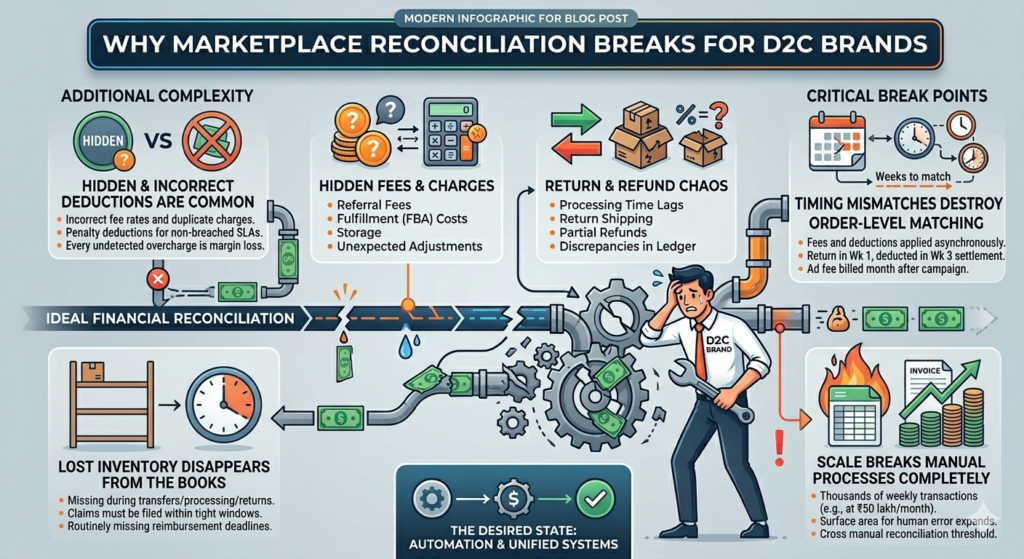
Why marketplace reconciliation breaks for D2C brands.

The Six Reasons It Breaks

Every marketplace speaks a different language

Amazon, Flipkart, Meesho, Myntra — each platform has its own report formats, field names, fee structures, and payout cycles. There is no standard. A commission on Amazon is documented differently from a commission on Flipkart, even if it's functionally the same deduction. Building a unified financial picture requires normalising incompatible data sources every single week.

Timing mismatches destroy order-level matching

Fees and deductions are applied asynchronously. A return initiated in Week 1 may be deducted from a settlement in Week 3. An advertising fee may be billed the month after the campaign ran. When your order data and your settlement data live on different temporal planes, matching them becomes an exercise in forensic accounting.

Returns are a reconciliation nightmare

High return rates — endemic in categories like fashion and electronics — create complex financial flows. Partial returns, RTO (return to origin) events, customer-initiated returns vs. courier-failed deliveries: each has different financial treatment. A returned item should trigger a refund reversal, a logistics credit, and sometimes a restocking fee. Whether all three actually appear in your settlement is far from guaranteed.

Hidden and incorrect deductions are common

Marketplace settlement systems can — and do — apply incorrect fee rates, duplicate charges, or unlisted penalties. Incorrect commission charges, duplicate logistics fees, penalty deductions for SLA violations that weren't actually breached: these are not edge cases. Without systematic matching against agreed rate cards, they go undetected indefinitely. Every undetected overcharge is permanent margin loss.

Lost inventory disappears from the books

Inventory can go missing during warehouse transfers, fulfillment processing, or returns handling — and marketplaces do offer reimbursement for verified losses. But claims must be filed within tight windows. Without regular reconciliation that specifically tracks inventory movement alongside financial settlements, brands routinely miss reimbursement deadlines and absorb losses that were technically recoverable.

Scale breaks manual processes completely

A brand doing ₹50 lakh/month in marketplace GMV might process thousands of transactions weekly. At low volumes, Excel-based reconciliation is merely painful. At growth-stage volumes, it's structurally impossible — the surface area for human error expands faster than the team can manage. Most brands cross the manual reconciliation threshold long before they realise it.

What gets left at the table

The financial impact compounds in ways that aren’t immediately visible. Consider a brand doing ₹1 crore monthly GMV across Amazon and Flipkart. At a 3% leakage rate, that’s ₹3 lakh per month — ₹36 lakh per year — quietly disappearing into incorrect deductions, missed reimbursements, and unrecovered returns. Not from fraud. Not from bad products. Just from financial opacity.

⚠️ The Claim Window Problem

Most marketplace reimbursement claims — for lost inventory, incorrect fees, or damaged goods — have strict filing deadlines, often 30–90 days from the original event. Brands running monthly or quarterly reconciliation cycles routinely miss these windows entirely. The loss is permanent and unrecoverable once the deadline passes.

Beyond direct revenue leakage, broken reconciliation creates second-order problems: inaccurate COGS data leading to flawed pricing decisions, incorrect GST Input Tax Credit (ITC) filings, and an inability to accurately measure per-SKU or per-channel profitability. Strategic decisions — which products to double down on, which marketplace to invest in — are being made on fundamentally unreliable numbers.

The Multi-Channel Complexity Multiplier

Most growing D2C brands don’t sell on just one marketplace. They sell on two, three, four — plus their own website, possibly retail, possibly quick-commerce. Each channel adds reconciliation complexity non-linearly, because the data models, settlement cycles, and fee structures don’t just add together; they create cross-channel matching problems that don’t exist in a single-channel world.

A return initiated on Flipkart that was originally advertised via a brand’s D2C website promotion creates a financial event that touches at least three separate systems. Tracking it — correctly, in real time — requires either a sophisticated unified reconciliation layer or an army of analysts working around the clock.

Where to Start

If you’re a D2C brand selling north of ₹20 lakh/month on marketplaces and still reconciling manually, the priority is simple: run a diagnostic first. 

Pull three months of settlement data, match it order-by-order against your OMS, and count how many transactions don’t match. The number will be higher than you expect.

From there, the build sequence matters: standardise your data ingestion first (get everything into one format), then automate matching, then layer in dispute workflows so detected discrepancies don’t just sit in a report — they get acted on.

The brands winning on marketplaces in 2026 aren’t just the ones with the best products or the best ads. They’re the ones who know, to the rupee, exactly what each channel actually costs them — and get paid every rupee they’re owed.

Reconciliation isn't an accounting task. It's a revenue recovery function. Treated correctly, it's one of the highest-ROI investments a scaling D2C brand can make.

Building an e-commerce operation and want to understand what a finance automation stack would look like for your specific setup? Get in touch, we help businesses architect systems that protect revenue and scale with confidence.

Business Solution

Tally + Excel vs Custom ERP Layer: The Smarter Path for Growing Manufacturers

For Indian manufacturing founders and CFOs navigating their next operational upgrade. The Tally vs ERP question for manufacturers is ultimately not about software preference, it is about operational maturity. There is a specific kind of Friday evening that every manufacturing...

Business Solution

Inside a Finance Automation System That Reduced Effort by 67%

Your Heading How we replaced a broken Excel-based commission process with a SQL-powered automation engine — cutting a 24-hour monthly cycle down to 8 hours. Every month, a team of finance specialists sat down with a sprawling Excel workbook. Their...

Business Solution

Refund Logic Commission Errors and Why Your Reports Never Match

Every ecommerce finance team has lived this moment: the monthly close is approaching, your payment gateway shows one number, QuickBooks shows another, and the affiliate dashboard appears to be operating in a separate dimension entirely. You reconcile for hours, patch...

Business Solution

Why Growing Manufacturing Businesses Can’t See What’s Happening Inside Their Own Operations

You’re running a manufacturing business that’s doing well. Somewhere between ₹20 crore and ₹100 crore in annual revenue. You have a plant, a team, orders coming in, and real customers who depend on you. And yet, every week, something surprises...

Ecommerce

Why Marketplace Reconciliation Breaks for D2C Brands

You're selling on Amazon, Flipkart, Meesho — revenue looks healthy. But quietly, 3–5% of your GMV is disappearing into a black hole of fees, return mismatches, and settlement gaps. Here's why it happens, and what modern D2C finance teams are...
