Business Solution
manufacturing operations visibility

Why Growing Manufacturing Businesses Can’t See What’s Happening Inside Their Own Operations

Anshuman Chhapolia
1 April 2026

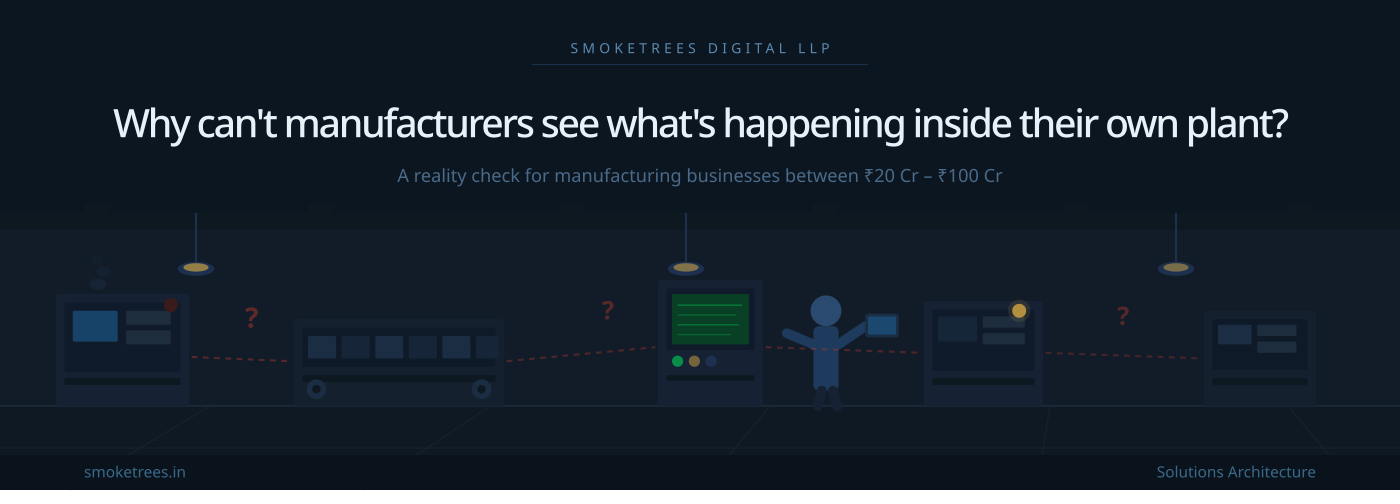
You’re running a manufacturing business that’s doing well. Somewhere between ₹20 crore and ₹100 crore in annual revenue. You have a plant, a team, orders coming in, and real customers who depend on you. And yet, every week, something surprises you.

A delivery goes out late. Raw material runs short three days before it should have. A machine goes down at the worst possible moment. You ask what happened, and the answer always starts with “we didn’t know until…”

This isn’t a people problem. It’s a visibility problem. And in my experience working with manufacturers at exactly this stage, it’s the single most consistent thing standing between where they are and where they want to be.

What "Visibility" Means Here

I mean something simple: knowing what’s actually happening across your plant — right now, not at the end of the shift, not in tomorrow morning’s report.

Most manufacturers in this revenue range don’t have that. Not because they’re poorly managed, but because they’ve grown into a kind of complexity their current tools weren’t built to handle. The tally sheets, the WhatsApp groups, the spreadsheets that get emailed around — these worked fine at ₹5 crore. At ₹50 crore, they’re leaving gaps everywhere.

The Problems That Show Up at This Scale


1. Nobody Has the Full Picture

At this stage, most plants are running a few different systems that don’t talk to each other. There’s usually something for accounts and inventory. A production register that someone maintains — manually, or in Excel. A maintenance record in a notebook or on WhatsApp. Maybe something else for dispatch.

Each of these captures real, useful information. The problem is they exist in completely separate worlds. When something goes wrong — a batch delay, a quality rejection, a raw material shortage — figuring out why means calling three different people and digging through three different places. By the time you’ve assembled the full picture, the damage is done and the moment to act has passed.

Nobody is doing anything wrong here. It’s just what happens when a business grows fast and adds tools as it needs them, without stepping back to ask whether those tools can actually work together.


2. Everyone Is Making Decisions on Yesterday’s Numbers

In many plants at this scale, the production head gets a report at 9am about what happened yesterday. The owner reviews a weekly summary that covers the last seven days. Procurement decisions are made based on inventory counts from two days ago.

This works fine when things are stable and predictable. But manufacturing rarely is. Customers change requirements. Machines behave unexpectedly. Suppliers miss commitments. When your information is already 24 or 48 hours old before it reaches anyone who can act on it, you’re permanently one step behind.

The teams aren’t slow or careless. They’re just working with what they have.


3. Machines Break Before Anyone Knew There Was a Problem

This is probably the most expensive gap at this scale, and it’s also the most avoidable.

When you don’t have a clear view of how your equipment is actually performing, you find out it’s failing the moment it stops. Not a day before. Not a shift before. The moment the line goes down.

Fixing a machine after it breaks costs significantly more than fixing it before it breaks — in repair costs, in production loss, in the chaos of a rushed response. For a plant doing ₹40 crore a year, a bad breakdown during a critical week can mean losing lakhs in a single day.

What makes this frustrating is that the warning signs are almost always there. A machine that’s about to fail usually shows it — through small changes in how it sounds, how long it takes to complete a cycle, how hot it runs. That information is often available. It’s just not reaching anyone who can act on it before the breakdown happens.


4. Inventory Is Either Too Much or Never Enough

This one is familiar to almost every manufacturer in this range. You’re either sitting on material you bought in excess “just to be safe,” tying up cash you could be using elsewhere — or you’re scrambling at the last minute because something ran out and nobody caught it in time.

Both keep happening for the same reason: nobody has a live, accurate view of what’s in stock, what’s being used on the floor, and what needs to be ordered. When that information lives in a spreadsheet that gets updated twice a week and isn’t connected to what’s actually happening in production, the numbers are always off by some degree. And small degrees, compounded over weeks, turn into real problems.


5. The Owner or MD Is Making Calls on Incomplete Information

At this revenue level, the person at the top is usually still deeply involved in key decisions. But the information reaching them is pieced together from multiple sources — the plant manager, the accounts team, the production register, their own floor walk.

Everyone has a piece of the picture. Nobody has the whole picture. Decisions get made on partial information, and when things go wrong, it’s genuinely hard to understand why — because the missing piece might be sitting in a system or a conversation that nobody thought to loop in.
What Actually Helps

The answer isn’t a massive technology project or a system replacement. For manufacturers at this scale, the right move is practical and focused.

  1. Get the information you already have into one place. Most plants are already generating enough data to make much better decisions. The problem is it’s scattered. The first step is simply pulling it together — so that production, inventory, maintenance, and dispatch are visible in one view, not four separate ones.
  2. Make the floor visible to whoever needs to see it. A simple live view of what’s happening on the floor — which orders are moving, which machines are running, what’s behind schedule — changes how quickly problems get noticed and addressed. Instead of waiting for the end-of-shift report, the right person knows within minutes.
  3. Connect what leaves the store to what’s happening in production. When your inventory is linked to what the floor is actually consuming, you stop making procurement decisions in the dark. You know a few days in advance that you’ll run short. You order before it’s urgent, not after it’s already a problem.
  4. Track maintenance before it becomes a crisis. Even something as simple as a clear record of which machines are due for service, paired with alerts when something’s been missed, reduces the number of surprises dramatically. It doesn’t need to be complicated. It just needs to exist.

What We've Built at Smoketrees Digital LLP

This is the kind of work we do. Our clients are mostly manufacturers in the ₹20–200 crore range — serious, growing businesses that are operationally complex but don’t have large internal IT teams.

We’ve built live production tracking systems for clients who were previously relying on end-of-shift phone calls to know where their orders stood. We’ve built inventory tools that alert the right person automatically when stock drops below a safe level — no spreadsheet, no manual check required. We’ve helped plants move from paper maintenance logs to a simple system that generates a preventive schedule and flags what’s overdue. And we’ve put together morning dashboards for owners and MDs that pull numbers from across the operation automatically — so the first conversation of the day is about what to do, not about what happened.

The thing that’s consistent across all of it: the problem is never that the information doesn’t exist. It’s that the information isn’t reaching the right people, at the right time, in a form they can actually use. That’s the problem we solve.

A Final Thought

If you’re running a manufacturing business in the ₹20–100 crore range and something here felt familiar, you’ve likely been absorbing the cost of this for a while — in late deliveries, excess stock, unexpected breakdowns, or decisions made on information that was already stale.

The manufacturers who pull ahead at this scale are almost always the ones who fix this first. Not because they have better equipment or cheaper inputs, but because they can actually see what’s going on inside their operations and respond to it quickly.

That’s what we help build. If it’s worth a conversation, reach out.

Smoketrees Digital LLP builds custom software for manufacturing businesses. We work with growth-stage companies to solve real operational problems — production tracking, inventory management, maintenance, and leadership reporting. Reach us at info@smoketrees.in or drop a message at Contact us

Business Solution

Tally + Excel vs Custom ERP Layer: The Smarter Path for Growing Manufacturers

For Indian manufacturing founders and CFOs navigating their next operational upgrade. The Tally vs ERP question for manufacturers is ultimately not about software preference, it is about operational maturity. There is a specific kind of Friday evening that every manufacturing...

Business Solution

Inside a Finance Automation System That Reduced Effort by 67%

Your Heading How we replaced a broken Excel-based commission process with a SQL-powered automation engine — cutting a 24-hour monthly cycle down to 8 hours. Every month, a team of finance specialists sat down with a sprawling Excel workbook. Their...

Business Solution

Refund Logic Commission Errors and Why Your Reports Never Match

Every ecommerce finance team has lived this moment: the monthly close is approaching, your payment gateway shows one number, QuickBooks shows another, and the affiliate dashboard appears to be operating in a separate dimension entirely. You reconcile for hours, patch...

Business Solution

Why Growing Manufacturing Businesses Can’t See What’s Happening Inside Their Own Operations

You’re running a manufacturing business that’s doing well. Somewhere between ₹20 crore and ₹100 crore in annual revenue. You have a plant, a team, orders coming in, and real customers who depend on you. And yet, every week, something surprises...

Ecommerce

Why Marketplace Reconciliation Breaks for D2C Brands

You're selling on Amazon, Flipkart, Meesho — revenue looks healthy. But quietly, 3–5% of your GMV is disappearing into a black hole of fees, return mismatches, and settlement gaps. Here's why it happens, and what modern D2C finance teams are...
