Business Solution

How Financial Automation Eliminates Revenue Leakage in High-Volume Ecommerce

Adarsh Singh
17 March 2026

What Is Financial Leakage in Ecommerce?​

Financial leakage refers to unintended loss of revenue or profit, money that should be in your bank account but isn’t. In high-volume e-commerce, leakage comes in dozens of forms:

  • Manual entry errors in order reconciliation
  • Duplicate payments to suppliers or refunds to customers
  • Missed revenue opportunities (wrong pricing applied, expired promotions still running)
  • Late or missed invoices from vendors that disrupt payment cycles
  • Inventory mismatches between accounting and actual stock
  • Untracked payment disputes and chargebacks that slip through cracks
  • Cash flow timing issues where money sits in the wrong accounts
  • Forgotten credits or adjustments that should have been applied

The average ecommerce business loses between 2-8% of revenue to leakage annually. For a $10 million operation, that’s $200,000 to $800,000 slipping away, silently and repeatedly.

But here’s the thing: most businesses don’t even measure it. They assume some level of shrinkage is just “part of doing business”, like weather or taxes. It’s not. Most of it is preventable.
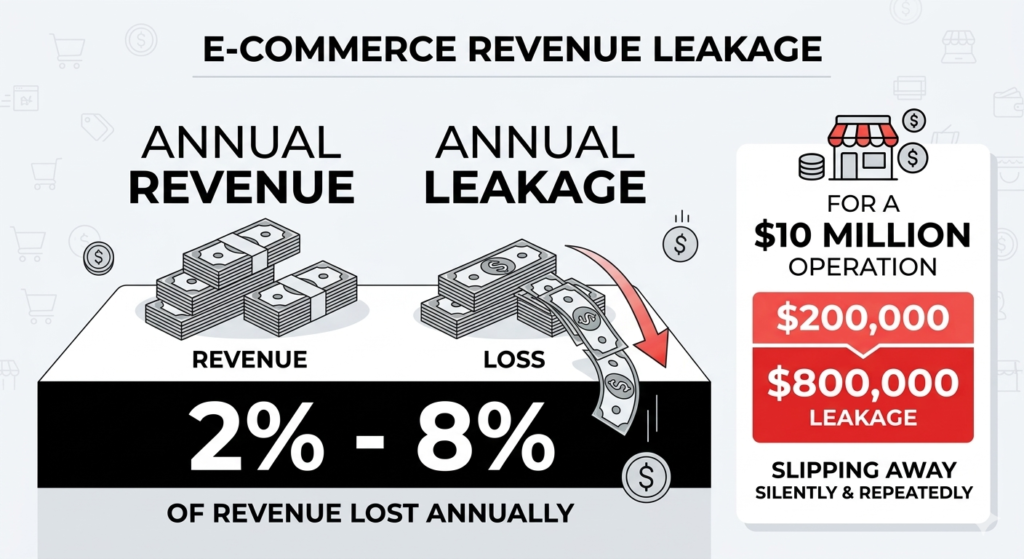
Annual loss due to financial leakage

Why Manual Finance Operations Create Leakage

Scale breaks humans. Not because they’re careless, but because they’re human.

When your ecommerce team is processing 50 orders a day, a human can manually reconcile payments and watch for errors. When you’re processing 500? That same person now has the cognitive load of a warehouse manager, an accountant, and a detective, all in their head.

The Three Ways Human-Driven Processes Leak Money

  1. Attention Bandwidth Is Finite

    Your finance team has limited attention. They can focus deeply on maybe 3-4 complex tasks per day. Beyond that, work becomes rote. Rote work is where errors hide.

    When a payment processor sends an unusual file format, or a customer dispute arrives with conflicting information, or a refund needs special handling, that’s where mistakes happen. Not from stupidity. From cognitive overload.

  2. Process Inconsistency Multiplies Errors

    When tasks are manual, they’re also inconsistent. One accountant might flag a chargeback on day one; another might miss it on day three. One team member processes refunds in order; another batches them by payment method.

    No two humans execute the same workflow identically, and that variance is where leakage compounds.

  3. Multi-Channel Payment Reconciliation Gaps

    Selling across multiple channels Shopify, Amazon, WooCommerce, your own shopfront, and wholesale portals mean payments arriving from multiple gateways with different fee structures, payout schedules, currencies, and data formats. Each gateway reports differently. Each has its own settlement logic.

    Reconciling this manually requires someone to export reports from each platform, normalise the data, and cross-reference it against bank deposits line by line. It’s tedious, error-prone, and slow. Discrepancies, missing payouts, double-counted fees, and timing mismatches often go undetected for weeks or months, precisely because no one has bandwidth to reconcile in real time.

    The downstream impact extends beyond the undetected discrepancies themselves. Delayed reconciliation means delayed financial close. When your books close 2–3 weeks after month-end, you’re making operational decisions on stale data, and that has a cost, even if it doesn’t appear on a single line of your P&L.

  4. Untracked Vendor Credits and Overpayments

    This is one of the most invisible forms of financial leakage. When vendors issue credits for returns, damaged goods, pricing corrections, or contractual adjustments, manually tracking those credits against future invoices is extraordinarily difficult at scale.

    Credits get lost in email threads. They aren’t applied before the next invoice is processed. The vendor gets paid in full again.
    Similarly, overpayments occur when invoices are paid without proper three-way matching against the original purchase order and goods receipt. A shipment that arrives short, a price negotiated down after the PO was raised, a quantity that changed these discrepancies are straightforward to catch in an automated system and easy to miss in a manual one.

    Untracked credits and overpayments represent a category of leakage where the money has already left your account and needs to be recovered, a far more difficult process than preventing the error in the first place.

Why High-Volume Ecommerce Is Especially Vulnerable

At scale, every percentage point matters. A 0.5% leakage rate on $10M in annual revenue is $50,000 walking out the door. At $50M, that’s $250,000.

High-volume operations are especially exposed for several reasons:

Transaction complexity compounds errors. The more payment gateways, currencies, fulfilment centres, and sales channels you operate, the more opportunities for discrepancies to appear and go undetected.

Manual processes don’t scale. Adding headcount to manage finance operations scales linearly with cost. Meanwhile, transaction volume and the risk attached to it scale exponentially during peak periods like holidays.

How Finance Automation Eliminates Leakage at the Source

This is where the shift happens.

Finance automation doesn’t eliminate human judgement, it eliminates the tasks that humans shouldn’t have to do manually in the first place. The repetitive, high-volume, rule-based work that is structurally prone to error at scale.

Where Finance Automation Wins Against Leakage

Consistency Without Exception

Automated workflows execute identically every time. A refund doesn’t get processed faster or slower depending on which team member handles it it gets processed on schedule, every time, with the same rules applied. No variance, no gaps.

Visibility in Real-Time

Automation creates audit trails. When a payment is processed, reconciled, or flagged, it’s logged immediately. You don’t find out about a discrepancy in next month’s reconciliation you see it in hours.

Automated Payment Reconciliation

Reconciliation software connects directly to your sales channels and payment gateways, automatically matching transaction records to bank deposits in real time. Discrepancies are flagged immediately rather than discovered weeks later. Financial close accelerates. And finance teams shift from spending hours on data matching to spending minutes reviewing exceptions.

For multi-channel ecommerce businesses, this is often the single highest-impact automation investment because the problem it solves grows with every channel added, while the solution’s cost does not.

AP Automation with Three-Way Matching

Automated accounts payable platforms introduce systematic three-way matching: every invoice is validated against its corresponding purchase order and goods receipt before payment is approved. Price mismatches, quantity discrepancies, and duplicate invoices are caught automatically.

Approval workflows become rule-based, and time-bound invoices route to the right approver automatically and escalate if not actioned within a defined window. Payment timing is optimised to capture early-payment discounts without requiring anyone to manually track which vendors offer them and when.

AR Automation

On the receivables side, automation handles invoice generation, delivery, and payment reminder sequences without manual intervention. Smart workflows send reminders at the right intervals, escalate based on invoice age, and route collections follow-up to the right team member with full context.

The output is a measurably healthier AR book, lower DSO (Days Sales Outstanding), fewer aged invoices, and more predictable cash flow without requiring additional headcount.

ERP and Accounting Integration

The connective tissue of finance automation is integration: ensuring data flows automatically between your e-commerce platforms, payment gateways, procurement systems, and accounting software (QuickBooks, Zoho Books, FreshBooks, Tally, and SAP) without manual export-and-import cycles.

When data moves automatically, it’s current. When it’s current, decisions made on it are better. When your financial close happens in days rather than weeks, you’re running your business on real information, not a snapshot from three weeks ago.

The Implementation Reality: Automation Doesn't Mean "Magic Button"

Let’s be honest: implementing finance automation is not a plug-and-play installation.

You need to:

  1. Map your current financial workflows (invoicing, reconciliation, refunds, etc.)
  2. Identify where automation adds the most value (usually payment processing and reconciliation first)
  3. Connect your systems (payment processors, accounting software, banking platforms)
  4. Define rules and exceptions (what should trigger alerts? What should auto-approve?)
  5. Test, iterate, and refine

This is where many ecommerce teams stumble. They buy automation software but never connect it to their operations properly. Or they set it up once and never optimise the rules.

The businesses that win are the ones that treat automation as an ongoing practice, not a one-time project. They refine rules quarterly. They add new automated workflows as their business scales. They use the visibility automation provides to identify new leakage points.

The Real Cost of Waiting

Financial leakage is like a slow puncture. You don’t notice until your tire is flat.

If you’re running a high-volume e-commerce operation and you haven’t audited your leakage in the last 6 months, you’re almost certainly losing money to manual process failures. And if you’re not automating those processes, that loss is growing every month.

The cost of waiting isn’t just the money you’re losing right now. It’s the opportunity cost: the team hours you could have reclaimed, the cash flow you could have optimised, and the strategic work your finance team could be doing instead of manual reconciliation.

Finance automation isn’t a luxury for large enterprises. It’s a necessity for any e-commerce business that wants to compete at scale.

A Practical Leakage Audit for E-commerce Businesses

Before investing in any automation tooling, it’s worth quantifying your current exposure. A focused self-audit should cover:

Invoicing and AP

  • What is your current per-invoice processing cost in staff hours?
  • How many invoices per month require manual correction?
  • What percentage of available early-payment discounts are you currently capturing?
  • How long is your average invoice approval cycle?

Reconciliation

  • How long does month-end close take from the last day of the month?
  • How many reconciliation discrepancies do you identify per month, and how old are they when found?
  • Are you reconciling each sales channel independently or in aggregate?

Accounts Receivable

  • What is your current DSO?
  • What is the total value of invoices 60+ days aged?
  • How are payment reminders currently managed – manually or systematically?

Assigning even rough dollar figures to each category almost always produces a number that makes automation investment look straightforward. The typical finding isn’t “we have a small problem” it’s “we’ve been accepting a large, preventable cost as a fixed operating reality.”

Where to Start

Not every business needs to automate everything at once. Prioritise based on where your leakage is most acute:

Highest priority for most high-volume e-commerce businesses: Payment reconciliation automation. The problem scales directly with transaction volume and channel count, the tools are mature and affordable, and implementation is typically fast.

High priority if you have significant vendor relationships: AP automation with three-way matching and optimised payment timing. Early-payment discount capture alone often justifies the cost.

High priority if cash flow is constrained: AR automation to reduce DSO and systematise collections. Shortening your receivables cycle by even 10-15 days can meaningfully shift your working capital position.

Build from there. The goal is a finance stack where data flows automatically, exceptions surface in real time, and your team’s judgement is applied to decisions, not data entry.

Conclusion

Financial leakage in high-volume ecommerce is almost always an operational problem, not a people problem. Skilled finance teams become bottlenecks when they’re managing thousands of transactions, invoices, and reconciliation items manually, not because they’re inadequate, but because the volume was never designed for human hands.

Finance automation doesn’t replace your finance function. It removes the structural ceiling on what your finance function can do. It transforms AP from a cost centre into a source of savings, reconciliation from a lagging report into a real-time view, and AR from a collections headache into a well-oiled cash flow engine.

The businesses that build this infrastructure early don’t just reduce leakage. They build a financial operating model that scales cleanly with growth and that’s a durable competitive advantage.

Building an e-commerce operation and want to understand what a finance automation stack would look like for your specific setup? Get in touch, we help businesses architect systems that protect revenue and scale with confidence.

References
  1. Thryv. The ROI of Invoice Automation, 2025. thryv.com
  2. ResearchGate. The ROI of Intelligent Automation: AI-Enhanced Financial Process Transformation, 2024–2025. researchgate.net
  3. Corpay. AP Automation ROI: The Definitive Guide. corpay.com
  4. HighRadius. AP Automation ROI Guide. highradius.com
  5. Artsyl Technologies. Invoice Processing Automation: 2025 ROI Formula Guide. artsyltech.com
  6. Tesorio. AR/AP Automation in 2025. tesorio.com
  7. Swell. 40 High-Risk Ecommerce Statistics for 2025. swell.is

Business Solution

How Financial Automation Eliminates Revenue Leakage in High-Volume Ecommerce

What Is Financial Leakage in Ecommerce?​ Financial leakage refers to unintended loss of revenue or profit, money that should be in your bank account but isn’t. In high-volume e-commerce, leakage comes in dozens of forms: Manual entry errors in order...

Uncategorized

The Hidden Cost of Running Your Business on Paper

At first glance, paper-based processes seem harmless. A few files here, some registers there, spreadsheets printed and signed, it feels familiar, affordable, and “good enough.”But beneath this comfort lies a growing, invisible cost that quietly slows your business down. If...

Case Study

How we saved time making estimates easy for property buying company

Client Overview Our client is a property investment and resale company that acquires residential properties, enhances their value, and sells them in the open market. Their business relies on accurate purchase price estimation to ensure strong margins and faster decision-making....

Case Study

When Off-the-Shelf Software Fails: A Case Study from Tixverse

Most businesses don’t fail because they lack software. They fail because the software they use stops fitting their reality. This is a short case study about Tixverse, an event ticketing platform, and how a seemingly small feature gap became a...

UX Design

The Calendar That Makes You Walk More: A Smarter Way to Track Your Daily Steps

Most step counters tell you how much you walked.Very few tell you how consistently you walked. That’s where this new step-tracking calendar changes the entire experience. It doesn’t just measure your movement.It visualizes your discipline. With a simple grid of...
