
Most businesses don’t fail because they lack software. They fail because the software they use stops fitting their reality.
This is a short case study about Tixverse, an event ticketing platform, and how a seemingly small feature gap became a serious business risk—and how custom development solved it.
The Context
Tixverse enables event organizers to publish and sell tickets across multiple event formats. As the platform grew, it began attracting organizers who hosted events in fixed‑seating venues:- Auditoriums
- Theatres
- Conference halls
The Problem Wasn’t Technical — It Was Business‑Critical
Tixverse did not support seat‑wise booking. This created a clear pattern:
- Organizers listed their events
- Realized seat selection wasn’t available
- Moved to competing platforms
This wasn’t a UX inconvenience. It directly impacted:
- Customer retention
- Revenue from high‑value events
- The platform’s perception in the market
Ignoring it wasn’t an option. The First Step Wasn’t Coding Before writing a single line of code, we stepped back to answer a more important question:
Should this be built or bought?
This decision matters far more than most teams realise.
Build vs Buy: The Real Evaluation
Option 1: Integrate an Existing Seat‑Mapping Service
On paper, this looked like the fastest route. But deeper analysis revealed problems:
- Very high licensing costs
- Pricing that scaled poorly with growth
- Limited control over user experience
- Long‑term dependency on an external vendor
What looked like speed upfront translated into structural cost and rigidity later.
Option 2: Build a Custom Seat Selection System
Building in‑house meant:
- Full control over the experience
- Tight integration with existing workflows
- Freedom to evolve the feature over time
- No recurring third‑party licensing costs
It required effort—but it aligned with Tixverse’s long‑term business model.
The decision was clear: build it.
The Solution
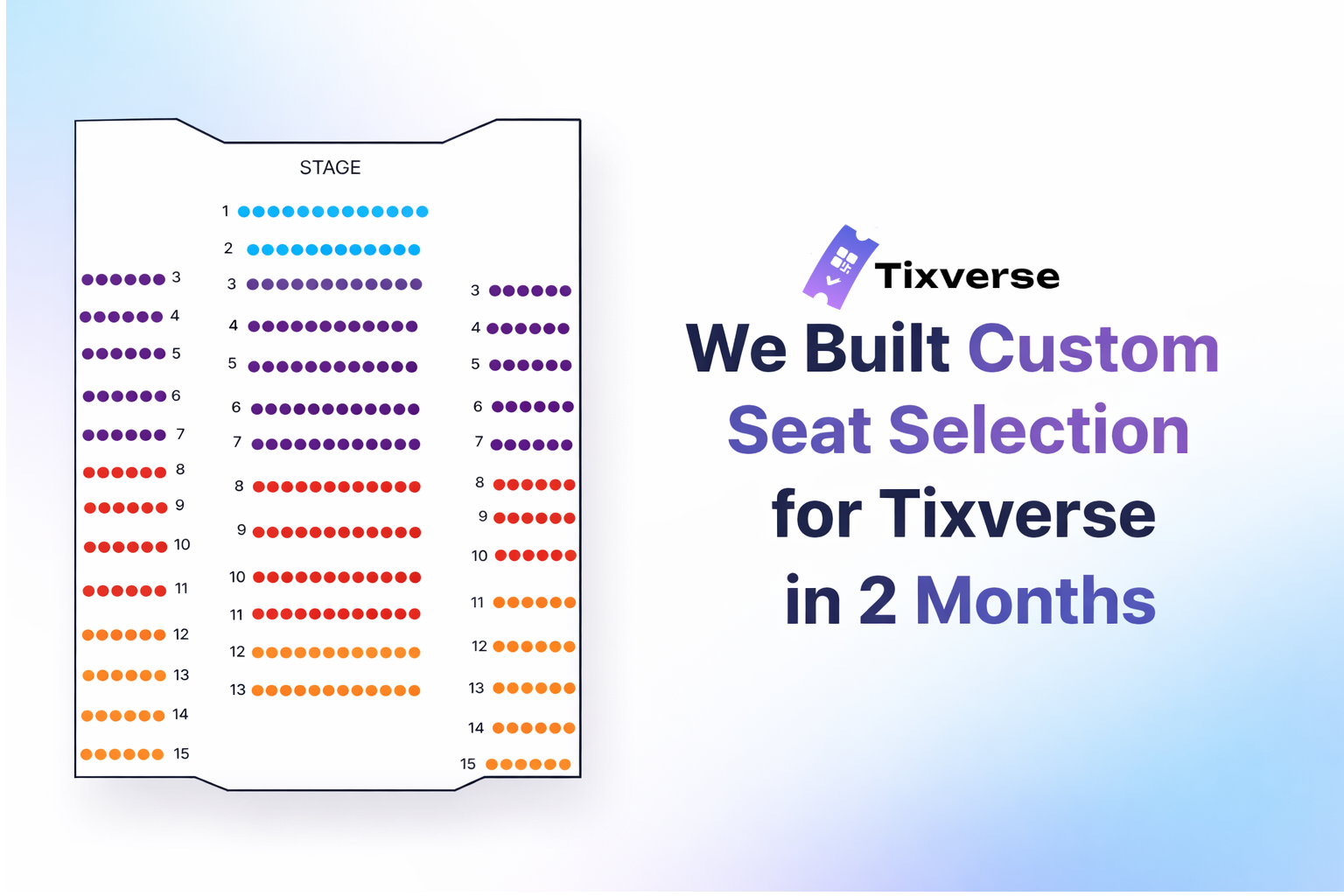
We designed and developed a custom seat selection module, built specifically for Tixverse’s platform. The focus wasn’t just functionality—it was fit.
The system supported:
- Visual seat layouts for different venue types
- Real‑time seat availability and locking
- Seamless flow from seat selection to payment
- Scalability across small and large venues
Everything was platform‑native. No external dependencies.
Execution Timeline
The entire feature went from idea to production in two months:
- Requirement analysis and system design
- Development and internal iterations
- Testing, edge cases, and production rollout
- Fast—but without cutting corners.
The Impact
- Event organizers requiring seat selection were retained
- New categories of events became viable
- Operational costs stayed predictable
- The platform strengthened its competitive position
- Most importantly, Tixverse removed a growth bottleneck.
The Larger Lesson
This case study isn’t really about seat selection.
It’s about a pattern we see repeatedly—especially with growing businesses and SMEs: Off‑the‑shelf tools work until they don’t. When that happens, forcing your business to adapt to software is usually the wrong move. Sometimes, the right answer is to build.
Why This Matters for ERP and SME Software?
This exact thinking is what we’re applying while building ERP systems for Indian SMEs. Not every problem needs a product. Not every product fits every business. The real value lies in:
- Understanding processes
- Identifying structural bottlenecks
- Building systems that match how the business actually works
Final Thought
Custom software isn’t about complexity. It’s about alignment.
When tools stop fitting your business, that’s not a failure. It’s a signal. And when you respond to that signal correctly, growth follows.